


The success of an immunofluorescence experiment depends, in large part, on antibody selection. Whether you are studying cellular localization, protein expression, or pathological tissue sections, antibody compatibility, specificity, and signal stability directly determine image quality and publication readiness.
Yet with thousands of antibodies available, selecting the right one remains a persistent challenge. Which validation data actually predicts IF performance? What distinguishes a high-quality clone from one that generates background noise or inconsistent staining?
This guide addresses those questions systematically. It covers 2 major selection methods and 6 key criteria, grounded in antibody development and validation principles, to help you make informed decisions and obtain reproducible, publication-quality IF images.
1. Principles and Applications of Immunofluorescence
Immunofluorescence, or IF, uses fluorescently labeled antibodies as probes to locate and qualitatively analyze specific antigens in tissues or cells. Because of its high specificity, strong sensitivity, and fast workflow, IF is widely used in scientific research and clinical diagnostics.
2. Two Major Immunofluorescence Labeling Methods
1. Direct Immunofluorescence Labeling
In direct immunofluorescence, antibodies labeled with different fluorophores, such as anti-A and anti-B antibodies, are mixed at an appropriate ratio and incubated with the experimental sample. After unbound fluorescent antibodies are washed away, the sample is observed under a fluorescence microscope to locate and qualitatively analyze the two antigens.
2. Indirect Immunofluorescence Labeling
In indirect immunofluorescence, two unlabeled specific primary antibodies from different host species are incubated sequentially with the tissue or cells. After excess primary antibodies are washed away, two secondary antibodies labeled with different fluorophores are used to incubate the tissue or cells. After removing excess secondary antibodies, the sample is observed under a fluorescence microscope to locate and qualitatively analyze the two antigens.
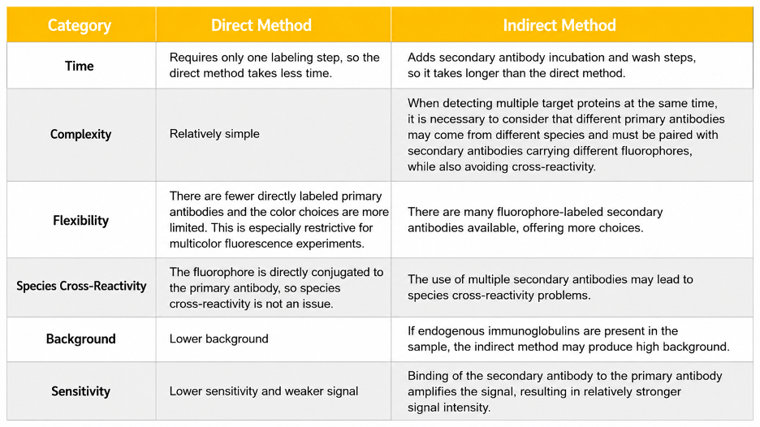
We have summarized and compared these two methods in terms of experimental time, complexity, flexibility, sensitivity, species cross-reactivity, and background signal. Please refer to the table below:
3. Immunofluorescence Antibody Selection Guidelines
If you are only studying the colocalization of two antigen proteins in cells, directly labeled primary antibodies are recommended, as they can relatively reduce the risk of secondary antibody cross-reactivity.
However, most laboratories currently use indirect immunofluorescence to study the colocalization of multiple target antigens in cells. Therefore, this guide focuses on how to select antibodies for indirect immunofluorescence.
Primary Antibody Selection Guide
Select the Primary Antibody Based on the Experimental Sample
The host species of the primary antibody should ideally be different from the species of the sample being tested. This helps avoid cross-reactivity between the secondary antibody and endogenous immunoglobulins in the sample.
For example, when testing mouse samples, try to avoid using mouse- or rat-derived primary antibodies. If a primary antibody from the same species must be used, an isotype control is recommended. A rabbit-derived primary antibody is usually a better choice, and the secondary antibody can then be a fluorophore-conjugated anti-rabbit IgG.
Secondary Antibody Selection Guide
Select Based on the Host Species of the Primary Antibody
The fluorophore-labeled secondary antibody must match the host species of the primary antibody. For example, if the primary antibody is mouse-derived, choose an anti-mouse secondary antibody, such as goat anti-mouse. If the primary antibody is rabbit-derived, choose an anti-rabbit secondary antibody, such as goat anti-rabbit.
Select Based on Antibody Class and Subclass
1. When the Primary Antibody Is a Monoclonal Antibody
The secondary antibody should target the class or subclass of the primary antibody. For example, if the primary antibody is mouse IgM, an anti-IgM secondary antibody should be selected. When using multiple subclass-specific primary antibodies, subclass-specific secondary antibodies should be used to distinguish between the primary antibodies.
For example, in an immunofluorescence double-labeling experiment using IgG1 and IgG2 primary antibodies, anti-IgG1 and anti-IgG2 secondary antibodies are the better choice.
2. When the Primary Antibody Is a Polyclonal Antibody
An IgG secondary antibody can be used, as most polyclonal antibodies are IgG immunoglobulins.
Select Based on the Type of Secondary Antibody
Tissues such as thymus, spleen, and blood, as well as hematopoietic cells, lymphocytes, and B cells, often express high levels of Fc receptors. The Fc region of a full-length secondary antibody can easily bind to Fc receptors, which may cause nonspecific binding. In these cases, F(ab')2 fragment antibodies are recommended to reduce nonspecific binding.
Select Based on the Purification Method of the Secondary Antibody
Cross-adsorbed secondary antibodies are further purified by passing them through columns containing immobilized serum or antibodies from other species. This process helps reduce interspecies cross-reactivity and offers clear advantages in multicolor analysis.
Select Based on the Fluorophore
Commonly used fluorescent labels include the ABflo® series, FITC, Rhodamine, Texas Red, PE, Cy3, and others.
For multicolor labeling, the expression abundance of each target and the signal intensity of each channel should be considered together. Whenever possible, pair low-abundance targets with brighter fluorophores and high-abundance targets with weaker fluorophores to achieve balanced signals.
4. Immunofluorescence Antibody Q&A
Q: What should I do if the antibody datasheet does not state that the antibody can be used for IF?
The first requirement is that the antibody must be validated for IF applications. When purchasing antibodies, carefully check the manufacturer’s datasheet to confirm whether the antibody is suitable for IF. Try not to test an antibody with a “let’s give it a try” mindset, as this often wastes time and can affect experimental confidence.
Q: Why does my antibody work very well in WB but not in IF?
First of all, congratulations on finding a strong WB antibody — obtaining a good WB antibody is not always easy.
However, the antibody may have been generated using a synthetic peptide immunogen and may primarily recognize a linear epitope. If the immunogen sequence is buried inside the native protein conformation, the antibody may only bind after the protein is denatured and the linear epitope is exposed. Therefore, do not assume that an antibody that performs well in WB will automatically work well in IF.
In experiments, it is still important to confirm whether the antibody is suitable for the intended application and to optimize experimental conditions as needed.
Q: Are the secondary antibodies for WB and IF the same?
Clearly, no. Secondary antibodies can be conjugated to different types of probes, including enzymes such as horseradish peroxidase, or HRP, alkaline phosphatase, or AP, and its derivatives such as APAAP and PAP; fluorophores such as FITC, Rhodamine, Texas Red, PE, and others; biotin; or gold particles.
Secondary antibodies used in WB are usually labeled with HRP or alkaline phosphatase and require chromogenic or chemiluminescent substrates, such as ECL, for signal detection. Secondary antibodies used in immunofluorescence, however, are labeled with fluorophores. Their signals require excitation by ultraviolet or appropriate fluorescence light sources and are observed using a fluorescence microscope.
ABclonal Recommended Primary Antibodies for Immunofluorescence
|
Catalogue Number |
Product Name |
Applications |
Reactivity |
GFAP Rabbit mAb |
WB, IF-F, IF-P, mIHC, ELISA |
Human, Mouse, Rat |
|
| A19086 |
WB, IF-F, IF-P, IHC-P, mIHC, ELISA |
Human, Mouse, Rat |
|
| A19776 |
AIF1/IBA1 Rabbit mAb |
WB, IF-F, IF-P, IHC-P, ELISA |
Human, Mouse, Rat |
| MAP2 Rabbit mAb |
WB, IF-F, IF-P, IHC-P, ELISA |
Human, Mouse, Rat |
|
|
A26746 |
Olig2 Rabbit mAb |
WB, IF-P, IHC-P, ELISA |
Human, Mouse, Rat |
|
WB, IF-P, IHC-P, mIHC, ELISA |
Human, Mouse, Rat |
||
| A23490 |
WB, IP, IF-F, IF-P, IHC-P, ELISA |
Human, Mouse, Rat |
|
| A24422 | β-Amyloid(1-42) Rabbit mAb |
WB, IF-P, IHC-P, DB, ELISA |
Mouse |
|
WB, IHC-P, IF/ICC, IP, ELISA |
Human, Mouse, Rat |
||
| A27819 | [KO Validated] Calnexin Rabbit mAb |
WB, IF/ICC, IHC-P, ELISA |
Human |
|
WB, IF/ICC, IF-P, IHC-P, ELISA |
Human, Mouse, Rat |
||
|
WB, IHC-P, IF/ICC, ELISA |
Human, Mouse |
||
|
WB, IHC-P, IF/ICC, IP, ELISA |
Human, Mouse, Rat |
||
|
WB, IF/ICC, IF-P, IHC-P, ELISA |
Human, Mouse, Rat |
||
|
WB, IP, IF/ICC, IF-P, IHC-P, ELISA |
Human, Mouse, Rat |
||
|
WB, IHC-P, IF/ICC, IP, ELISA |
Human, Mouse, Rat |
||
|
WB, IF/ICC, IF-P, IHC-P, mIHC, ELISA |
Human, Mouse, Rat |
||
|
WB, IF-F, IF-P, IHC-P, ELISA |
Human, Mouse |
||
|
WB, IF-F, IF-P, IHC-P, mIHC, ELISA |
Human, Mouse, Rat |
||
|
WB, IF-P, IHC-P, ELISA |
Human |
||
|
WB, IHC-P, IF/ICC, FC, ELISA |
Human |
||
|
WB, IHC-P, IF/ICC, ELISA |
Human, Mouse |
||
|
WB, IF/ICC, IF-F, IF-P, IHC-P, ELISA |
Human, Mouse, Rat |
||
|
WB, IF-P, IHC-P, ELISA |
Human, Mouse, Rat |
||
|
WB, IF-P, IHC-P, ELISA |
Human, Mouse, Rat |
||
|
WB, IF-F, IHC-P, ELISA |
Human, Mouse, Rat |
||
|
WB, IF/ICC, IF-F, IHC-P, mIHC, ELISA |
Human, Mouse, Rat |
||
|
WB, IHC-P, IF/ICC, IP, ELISA |
Human, Mouse, Rat |
ABclonal Recommended Secondary Antibodies for Immunofluorescence
|
Catalogue Number |
Product Name |
Host |
Type |
Application |
Reactivity |
|
Goat |
Secondary anti-Rabbit |
IF/ICC, FC |
Rabbit |
||
|
Goat |
Secondary anti-Rabbit |
IF/ICC, FC |
Rabbit |
||
ABflo® 488-conjugated Goat anti Mouse IgG (H+L)
|
Goat |
Secondary anti-Mouse |
IF/ICC, FC |
Mouse |
|
ABflo® 488-conjugated Goat anti-Mouse IgG (H+L) |
Goat |
Secondary anti-Mouse |
IF/ICC, FC |
Mouse |
|
ABflo® 488-conjugated Donkey anti-Rabbit IgG (H+L) |
Donkey |
Secondary anti-Rabbit |
IF/ICC, FC |
Rabbit |
|
|
Goat |
Secondary anti-Mouse |
IF/ICC, FC |
Mouse |
||
|
Goat |
Secondary anti-Rabbit |
IF/ICC, FC |
Rabbit |
||
| ABflo® 594-conjugated Goat anti-Mouse IgG (H+L)
|
Goat |
Secondary anti-Mouse |
IF/ICC, FC |
Mouse |
|
|
Goat |
Secondary anti-Rabbit |
IF/ICC, FC |
Rabbit |
||
| ABflo® 647-conjugated Goat anti-Mouse IgG (H+L)
|
Goat |
Secondary anti-Mouse |
IF/ICC, FC |
Mouse |
|
| AS072 | ABflo® 750-conjugated Goat anti-Rabbit IgG (H+L) |
Goat |
Secondary anti-Rabbit |
IF-P, FC |
Rabbit |
| AS007
|
Goat |
Secondary anti-Rabbit |
IF/ICC, FC |
Rabbit |
|
| AS008
|
Cy3-conjugated Goat anti-Mouse IgG (H+L)
|
Goat |
Secondary anti-Mouse |
IF/ICC, FC |
Mouse |
|
Goat |
Secondary anti-Rabbit |
IF/ICC, FC |
Rabbit |
||
|
Goat |
Secondary anti-Mouse |
IF/ICC, FC |
Mouse |
||
|
Donkey |
Secondary anti-Goat |
IF/ICC |
Goat |
||
|
Goat |
Secondary anti-Rat |
IF/ICC, FC |
Rat |
||
|
Goat |
Secondary anti-Rabbit |
IF/ICC, FC |
Rabbit |
||
|
Goat |
Secondary anti-Mouse |
IF/ICC, FC |
Mouse |