
Apr 6, 2021 10:00:00 AM       by Dennis Miao

5 Essential Tips You Need to Know for the Lab

As a dedicated supplier of research reagents, we're passionate about making sure that your experiments run as smoothly and efficiently as possible. From our ABclonal Knowledge Base, we've compiled a list of helpful articles that address common issues and difficulties that you may run into while conducting your lab experiments, including ELISAs, measuring cell proliferation, western blotting, and casting SDS-PAGE gels. If you're looking for advice, troubleshooting tips, or recommended procedures, we've got you covered:


Feb 1, 2021 3:53:38 PM       by Dennis Miao

Transcriptional Regulation of Myogenic and Metal Homeostasis Genes

On January 12, 2021, we had the privilege of hosting Dr. Teresita Padilla-Benavides, an Assistant Professor of Molecular Biology and Biochemistry at Wesleyan University in Middletown, CT, to present our first webinar of the new year. Her webinar discussed her research on the differential mechanisms for transcriptional regulation of myogenic and metal homeostasis genes. If you missed the live session of the webinar, we’ve got you covered here with a link to a recording of the webinar, as well as a recap below:


Dec 3, 2020 12:00:00 PM       by Dennis Miao

Webinar Recap: Monoclonal Antibodies in Cancer Therapy

For the second installment in our ABclonal Webinar Series, we had the privilege of inviting Dr. Clarke Gasper, our Business Development Scientist, to share his insights on the production and development of monoclonal antibodies for cancer therapy. If you were unable to attend the live session or would like to review some of Dr. Gasper’s key points, we’ve got you covered with a recap of his lecture below.


Nov 25, 2020 5:27:12 PM       by Kashyap Gayathri

Necroptosis: The Inflammatory Counterpart of Good Ol’ Apoptosis

A Bird’s Eye View of Necroptosis

Necroptosis is a type of regulated necrotic death driven by defined molecular pathways. Regulated necrosis regulates programmed cell death. Necroptosis is at the center of the pathophysiology of several clinically-relevant disease states, including myocardial infarction and stroke, atherosclerosis, ischemia-reperfusion injury, pancreatitis, and inflammatory bowel disease. Necroptosis results in necrosis-like morphological changes, such as cell swelling, plasma membrane pore formation, and membrane rupture. It also requires co-activation of receptor-interacting protein (RIP) 1 and RIP3 kinases. Necrosome is a complex formed by RIP1, RIP3 and Fas-associated proteins with death domain (FADD). Several studies in the preclinical stage have demonstrated that targeting necrosome can have variable effects on progression of tumors, indicating that it is largely cell-type or context dependent.


Nov 18, 2020 3:00:00 PM       by Kashyap Gayathri

Autophagy: A Natural Detox

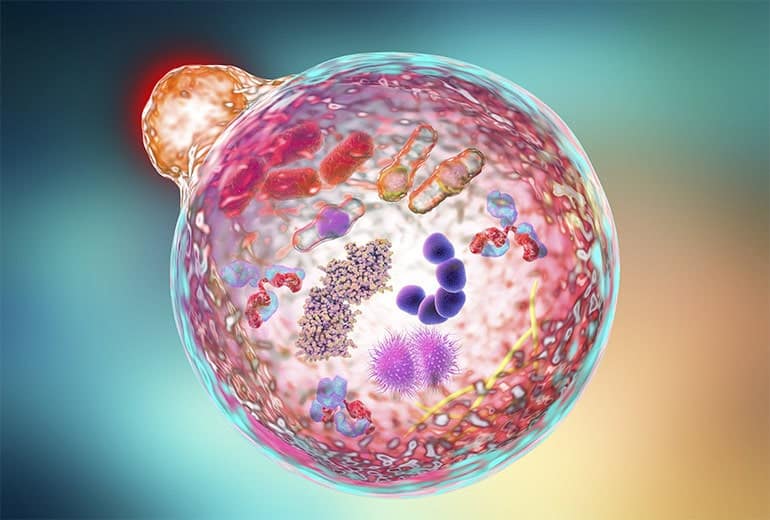
Autophagy can be understood as ‘self-eating’. In simple terms, it is a vitally important cleansing mechanism carried out by the cells in our body. It brings about the degradation of the cytoplasmic contents within membrane bound vesicles called lysosomes.


Nov 12, 2020 1:00:00 PM       by Bryent Lee

Ferroptosis as a New Type of Inflammatory Programmed Cell Death

When it comes to programmed cell death (PCD), apoptosis is usually the first process that comes to mind. However, there is a new type of inflammatory PCD discovered in 2012, known as ferroptosis, that is genetically and biochemically distinct from other PCD.1